Quick Answer
Financial assistance may be available for some Florida home-elevation projects, but there is no universal FEMA grant that automatically pays to raise a house.
Depending on the property, disaster, flood-insurance status, local government participation, and active funding cycle, potential assistance may involve programs such as Elevate Florida, FEMA Flood Mitigation Assistance, the Hazard Mitigation Grant Program, or Increased Cost of Compliance coverage through an NFIP flood-insurance policy.
These programs do not all work the same way.
Some are grants administered through government applicants. ICC is insurance coverage—not a general grant. Program availability also changes, so homeowners should verify current status before making financial decisions.
Current program status
The original Elevate Florida intake ran February 7 through April 11, 2025. This page was reviewed August 17, 2026. Check the current FDEM program page before relying on availability.
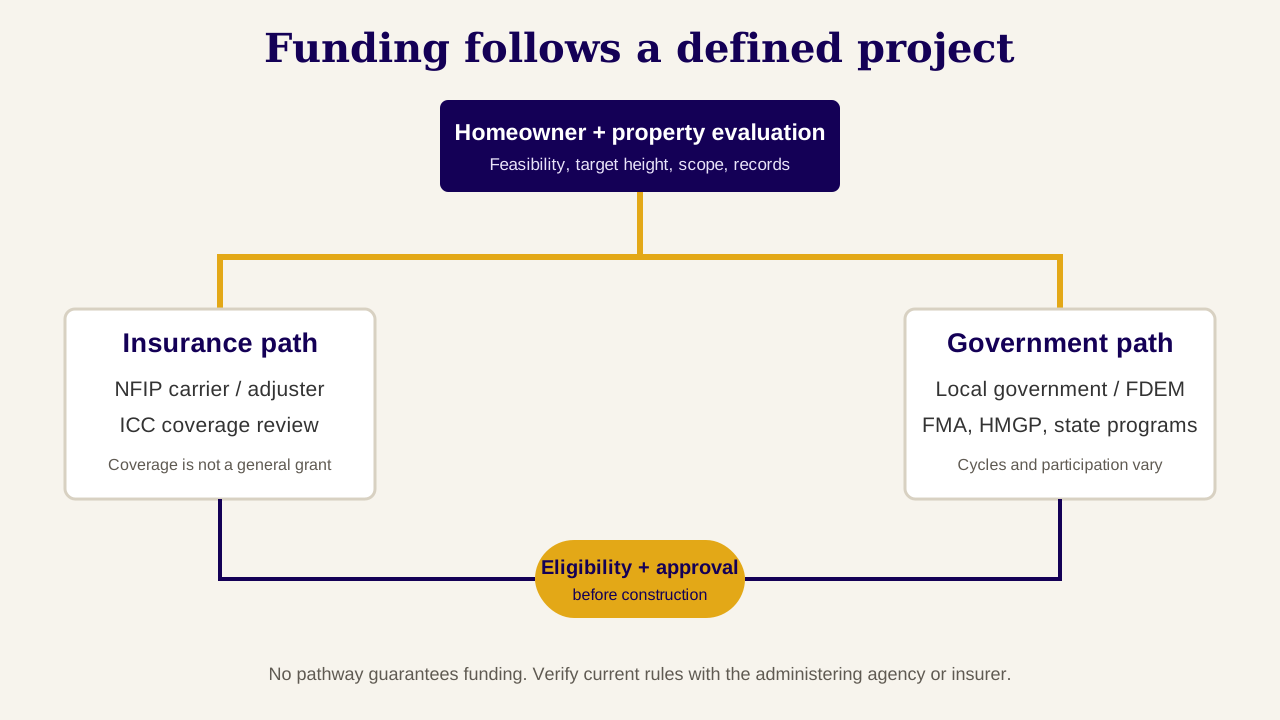
Are There Grants to Elevate Houses in Florida?
Yes, structural elevation is an eligible mitigation activity under multiple federal and Florida-administered programs.
But “FEMA will pay to raise my house” is an oversimplification.
The funding process can depend on:
- which program is active;
- whether the local government participates;
- property and flood-loss history;
- NFIP status;
- cost effectiveness;
- technical feasibility;
- available federal funding;
- required non-federal cost share;
- environmental and historic review;
- Duplication of Benefits;
- and approval of the actual mitigation project.
For some programs, the homeowner does not apply to FEMA directly.
That distinction is extremely important.
What Is Elevate Florida?
Elevate Florida is a statewide residential mitigation initiative administered by the Florida Division of Emergency Management.
The program offered several mitigation project types, including:
- Structure Elevation;
- Mitigation Reconstruction;
- Wind Mitigation;
- and Acquisition/Demolition. (Florida Disaster)
The original residential application period ran from February 7 through April 11, 2025.
FDEM reports receiving more than 12,000 applications from residents in 64 Florida counties. (Florida Disaster)
Is Elevate Florida Accepting New Applications Right Now?
As of this article’s review date, August 17, 2026, homeowners should not interpret Elevate Florida’s website as an open general application portal for the original 2025 intake.
FDEM states that the program’s Stage 1 application-submittal period occurred from February through April 2025 and that applications have continued through review and FEMA funding processes. (Florida Disaster)
Because mitigation-program status changes, homeowners should check FDEM directly for new application rounds, future programs, or updated guidance.
This article should be updated whenever FDEM changes the program’s application status.
How Is Elevate Florida Funded?
FDEM states that Elevate Florida uses federal mitigation funding through the Flood Mitigation Assistance Swift Current Program and the Hazard Mitigation Grant Program. (Florida Disaster)
Understanding those underlying programs helps homeowners understand why approvals can take time and why an application is not the same as a guaranteed award.
What Is FEMA Flood Mitigation Assistance?
The Flood Mitigation Assistance Program, commonly called FMA, is a FEMA grant program intended to reduce or eliminate flood risk and future claims associated with NFIP-insured buildings.
FEMA describes FMA as a competitive grant program providing funding to states, territories, local governments, and Tribal governments. (FEMA)
In Florida, eligible FMA project activities include Structure Elevation as well as acquisition, mitigation reconstruction, floodproofing, retrofit projects, and other mitigation work. (Florida Disaster)
Can a Florida Homeowner Apply Directly for FMA?
Generally, not as the eligible government subapplicant.
FDEM identifies eligible FMA subapplicants as government entities such as state agencies, eligible Tribal governments, and local governments/communities.
FDEM specifically tells owners of previously flooded structures who want mitigation assistance to consult their local or Tribal government about submitting an application on their behalf. (Florida Disaster)
That means a homeowner interested in FMA should not assume that filling out a general FEMA form directly creates an individual elevation grant.
The local-government process matters.
What Is the Hazard Mitigation Grant Program?
The Hazard Mitigation Grant Program, or HMGP, is another FEMA program administered in Florida by FDEM.
HMGP supports long-term hazard-mitigation measures following major disaster declarations.
FDEM explains that Florida’s project-selection process involves each county’s Local Mitigation Strategy Working Group and identifies Acquisition-Elevation among its project categories. (Florida Disaster)
FEMA likewise explains that individual property owners work through state, local, Tribal, or territorial government processes rather than receiving HMGP funding as direct FEMA applicants. (FEMA)
How Is HMGP Different From FMA?
Both programs can support flood mitigation, but they are not interchangeable.
A simplified comparison:
| Program | Basic purpose | Homeowner path |
|---|---|---|
| FMA | Reduce flood risk involving eligible NFIP-insured buildings | Generally through an eligible government subapplicant |
| HMGP | Support long-term mitigation after qualifying disaster declarations | Generally through state and local mitigation processes |
| Elevate Florida | Florida-administered residential mitigation using federal funding | Program-specific state intake and review |
| ICC | Insurance coverage for qualifying compliance costs | Claim and coverage review through the NFIP insurer |
The exact eligibility and cost-share rules should always be verified for the applicable funding cycle.
What Is Increased Cost of Compliance Coverage?
Increased Cost of Compliance, or ICC, is different from the grant programs above.
ICC is part of many Standard Flood Insurance Policies under the National Flood Insurance Program.
For qualifying policyholders in high-risk flood areas who must comply with floodplain-management requirements following qualifying flood damage, FEMA states that ICC coverage can provide up to $30,000 toward eligible mitigation work. (FEMA)
Eligible measures can include elevation and certain other compliance activities.
That makes ICC potentially valuable—but it is important to describe it correctly:
ICC is insurance coverage. It is not a general $30,000 FEMA home-elevation grant available to every homeowner.
Who May Qualify for ICC?
Eligibility depends on NFIP policy terms and the property’s circumstances.
A local floodplain determination is an important part of the process.
A homeowner should work with:
- the flood-insurance carrier or adjuster;
- local floodplain officials;
- and the project team
to understand whether ICC applies.
Do not begin a project assuming that ICC reimbursement is guaranteed.
Does the FEMA 50% Rule Automatically Give You $30,000?
No.
A substantial-damage determination and ICC eligibility are related concepts in certain flood-loss situations, but one should not be treated as automatic proof of the other.
The local authority determines substantial-damage and floodplain-compliance requirements.
The insurer determines the applicable policy claim and ICC coverage.
Read Fortified’s Florida FEMA 50% Rule resource for the separate substantial-damage discussion.
What Is Duplication of Benefits?
Federal mitigation programs generally cannot pay twice for the same eligible loss or project cost.
For example, a homeowner may have received:
- insurance proceeds;
- FEMA assistance;
- another government grant;
- or other recovery funding.
Program administrators may review those payments to determine whether they overlap with costs being requested through a mitigation program.
FDEM’s FMA project materials specifically include a Duplication of Benefits Disclosure for structure-elevation projects, and Elevate Florida also incorporates Duplication of Benefits review into its process. (Florida Disaster)
This does not necessarily mean receiving insurance money makes someone ineligible.
It means the sources and uses of funds have to be reconciled under applicable program rules.
Does Receiving a Grant Mean the Homeowner Pays Nothing?
Not necessarily.
Federal mitigation programs can involve cost-sharing arrangements, and the applicable percentage can vary by program, project, funding cycle, and property characteristics.
Some projects or qualifying categories can receive a larger federal share than others.
Homeowners should use the actual award and program documentation—not an online percentage—to determine their required contribution.
Avoid selecting a contractor or beginning construction based on an assumed grant percentage before the project’s funding conditions are clear.
What Types of Costs Can an Elevation Project Include?
A structural home-elevation project is larger than the physical lifting operation.
Depending on the project and what the program recognizes as eligible, costs may involve:
- engineering;
- surveying;
- geotechnical work;
- permitting;
- utility work;
- structural lifting;
- temporary support;
- demolition of affected components;
- new foundations;
- piles or other foundation systems;
- stairs and access;
- flood-compliant construction;
- Elevation Certificates;
- inspections;
- and project closeout.
Funding programs determine their own eligible and ineligible costs.
A contractor estimate should therefore be coordinated with program requirements when a project is grant funded.
What Documentation Should Florida Homeowners Keep?
If you think your home may qualify for mitigation funding, preserve records early.
Useful documents can include:
- flood-insurance policy information;
- insurance claim documents;
- damage photographs;
- substantial-damage determinations;
- Elevation Certificates;
- surveys;
- property records;
- repair estimates;
- contractor estimates;
- engineering reports;
- receipts;
- prior FEMA assistance records;
- correspondence with local government;
- and documentation of other funding received.
Keeping organized records can make it easier to respond when a program requests supporting information.
What Is an Elevation Certificate’s Role?
An Elevation Certificate documents important building and flood-elevation information.
FEMA uses the certificate as an administrative tool for floodplain-management information, and Florida maintains a statewide system for completed certificates. (FEMA)
Depending on the grant and project phase, elevation documentation may be needed to establish existing conditions, design the project, or verify the completed elevation.
Should You Wait for a Grant Before Evaluating Your House?
Not necessarily.
There is a difference between starting construction and understanding your options.
A homeowner may still benefit from determining:
- whether the structure can be elevated;
- what flood elevation applies;
- whether rebuilding might make more sense;
- what the estimated project scope looks like;
- and what documentation is missing.
However, homeowners pursuing federal or state mitigation funding should be cautious about beginning work before receiving required program approvals.
Some grant programs have strict rules about work performed before authorization.
Confirm those rules with the administering government agency before entering construction commitments.
How Can Fortified Home Elevations Help?
Fortified Home Elevations is a structural home-elevation contractor serving Florida’s Gulf Coast from Tampa Bay to Naples.
Our role is not to promise that FEMA or the State of Florida will fund a project.
Our role is to help homeowners understand the construction side of structural elevation:
- whether the existing structure appears to be an elevation candidate;
- what engineering and site issues need evaluation;
- what target elevation may be involved;
- how structural lifting is performed;
- what permanent foundation will be required;
- and what construction scope may be necessary.
For projects involving government mitigation funding, that construction information can become part of a much larger process involving the homeowner, local government, FDEM, FEMA, engineers, surveyors, insurers, and other stakeholders.
Where Should You Verify Current Funding?
Because funding programs change, use authoritative government sources as the final source of truth.
Start with:
Florida Division of Emergency Management
for Elevate Florida, Florida FMA, HMGP, and current mitigation-program information.
FEMA
for federal FMA, HMGP, NFIP, and ICC guidance.
Your local government
for community mitigation applications, Local Mitigation Strategy information, substantial-damage determinations, and local floodplain requirements.
Your NFIP insurer
for property-specific ICC questions.
The Bottom Line
There are real programs that can help fund qualifying Florida flood-mitigation projects, including structural home elevation.
But there is no one-size-fits-all “FEMA elevation grant.”
The correct path depends on the property, program, funding cycle, insurance status, local participation, and approval process.
Before making a construction decision, answer these questions:
- Does my property need or benefit from elevation?
- Can my existing house be safely elevated?
- How high does it need to go?
- What will the complete project involve?
- Which funding programs, if any, currently apply to my situation?
Once those answers are clear, a homeowner can evaluate funding and construction as one coordinated decision rather than chasing a grant without knowing what project is actually needed.
Frequently Asked Questions
Is FEMA currently giving grants to Florida homeowners to elevate houses?
FEMA funds mitigation programs, but homeowners generally should not assume there is a continuously open direct-to-homeowner FEMA grant. Availability and application paths depend on the specific program and funding cycle.
Is Elevate Florida still open?
The original Elevate Florida residential application window ran from February 7 through April 11, 2025. Existing applications continued through review and funding processes. Homeowners should check FDEM for any new or reopened program opportunities. (Florida Disaster)
Can FMA pay for structural elevation?
Structure elevation is an eligible FMA mitigation project type in Florida. Eligible government entities submit applications; property owners should work with their local government regarding potential participation. (Florida Disaster)
What is the FEMA $30,000 elevation benefit?
This usually refers to qualifying Increased Cost of Compliance coverage available under certain NFIP flood-insurance situations. FEMA states eligible policyholders may receive up to $30,000. It is insurance coverage rather than a general homeowner grant. (FEMA)
Can I use insurance and grant funding together?
Potentially, but overlapping benefits may require a Duplication of Benefits review. Program administrators determine how previous assistance affects the project’s eligible funding.
Should I start construction while waiting for grant approval?
Do not assume you can. Federal/state mitigation programs can restrict costs or construction initiated before required approvals. Verify program rules before authorizing work.
Define the project first: compare elevation with rebuilding, determine whether the existing structure may be lift-suitable, and establish the required project elevation.
Define the project before relying on funding
Fortified can help identify the construction questions and documents needed for a property-specific feasibility review. Funding and coverage decisions remain with the administering agency or insurer.
Request a Home-Elevation Feasibility Assessment